
Overview
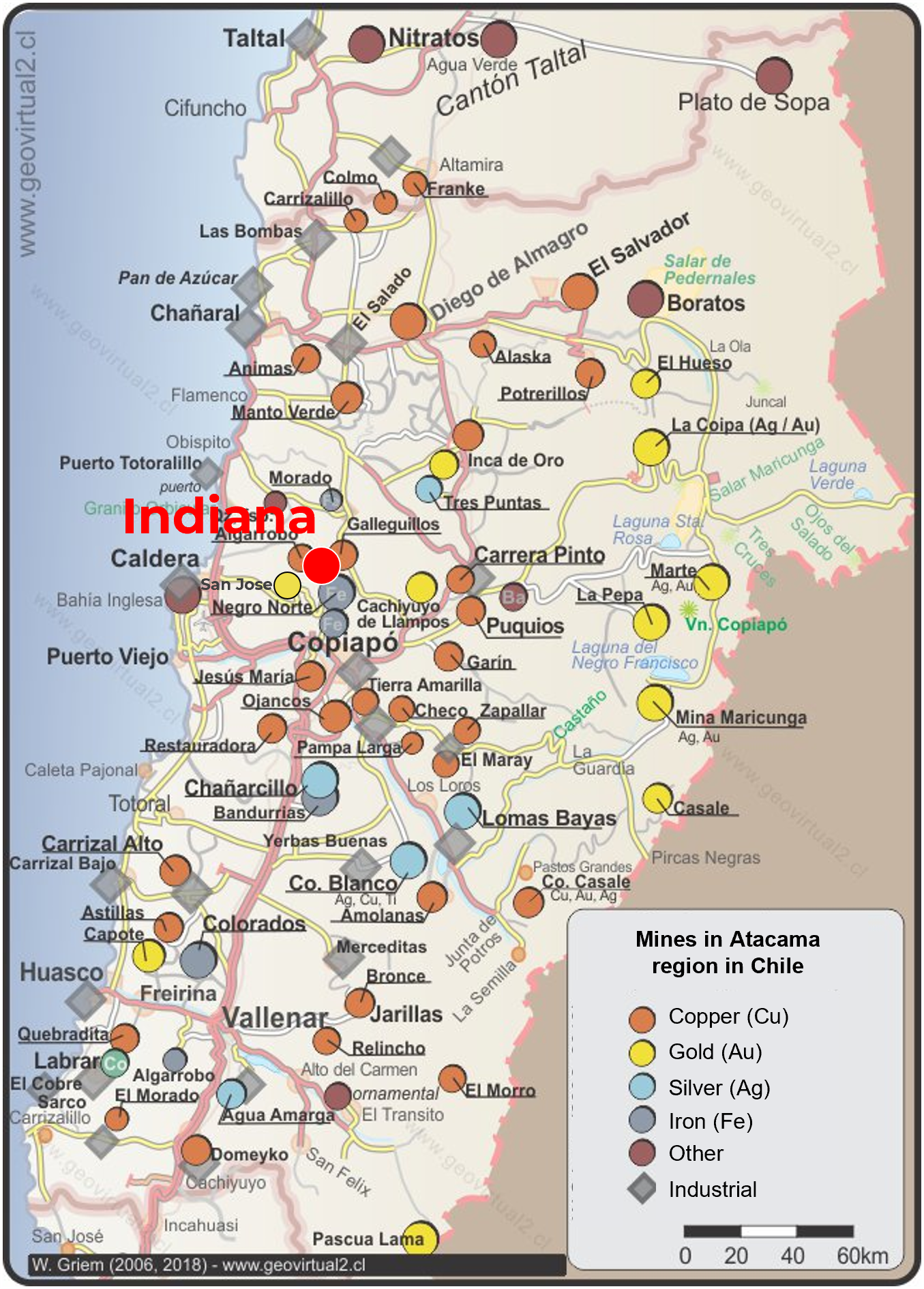
Indiana is an operating gold-copper mine in the Atacama region of northern Chile. That region ranks among the world’s most productive mineral belts. Indiana is at low elevation, just 30 kilometers north of the mining center of Copiapó and is accessible by paved road.
Galantas secured an option to acquire the mine in November in a transaction that also enhanced the management and technical team. The mine is permitted and in production. At present, ore is trucked to a processing facility near Copiapó while permitting is underway for a process facility on-site.
The area hosts several large deposits, hosting world-class mining operations. Indiana shares geological traits with those larger deposits. In addition to the opportunity to rapidly boost production, Indiana offers exciting exploration potential.
Location
Indiana is located in Chile’s Atacama Region (Region III) at an elevation of approximately 800 meters above sea level and 30 km north of the city of Copiapó. Indiana is easily accessed from Copiapó on high quality paved roads. Copiapó, a city of 175,000 people, is the most important hub for the mines in the Atacama Region. The nearby airport provides a convenient transportation link. The Caldera Port, just 76 km by road from Copiapó, is the main shipping point for mineral production from the region.
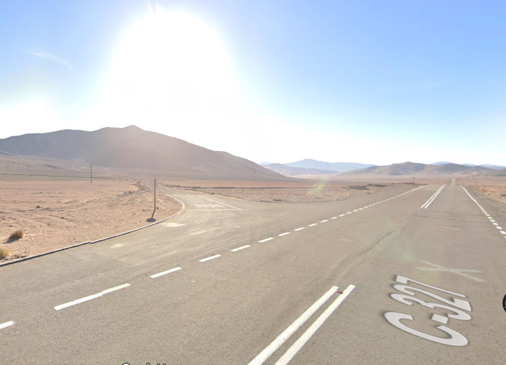
Immediately adjacent to the Indiana property is the Cerro Negro iron mine, which produces iron ore concentrate on a large scale. There are numerous other mines in the immediate area of Indiana and throughout the Atacama Region.
Operation
Indiana is exploiting a series of high-grade veins. There are 12 existing access points into the veins, providing enormous flexibility and scope for quickly ramping up production.
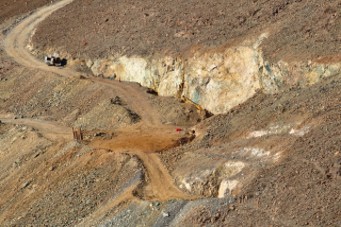
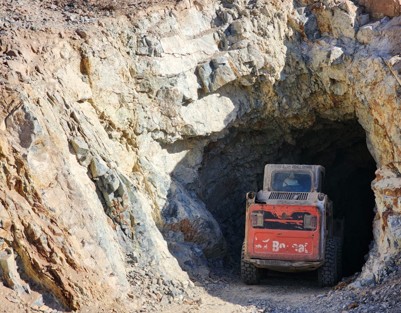
Over the past year, the mine was exploited on a small scale, with contractors driving 1.5 kms of tunnels along several of the veins. This was primarily an exploration effort which served to confirm grade and continuity of the veins. That mining also provided a bulk sample which confirmed the metallurgy. The ore was trucked to a toll milling facility south of Copiapó.
The existing tunnels are suitable for underground mining. Our immediate plan is to get drill rigs into the tunnels and do drilling in order to support a detailed mine plan. We will then begin to extract the veins with conventional underground mining. We plan to be mining at a rate of 300 tpd by mid-2026 and continue to ramp up production. Ore will initially be trucked to an existing processing plant as the permit process is underway for an on-site plant.
The upper portions of the deposit are oxidized while the lower part is sulphide, with ore of each type to be trucked to the appropriate process plant. There is a transition zone which hosts an enriched chalcocite blanket.
Geology and Exploration
The Indiana deposit is located within the Atacama Fault System, a major structural feature in northern Chile associated with several large deposits, including:
- The Cerro Negro mine, immediately adjacent to Indiana, produces 4 million tonnes per year of iron ore concentrate.
- Mantovrde, 55 km north, produces 100,000 tonnes per year of copper and is owned by Capstone, a C$10 billion company.
- Candelaria, 50 km south of Indiana, produces 145,000 tonnes of copper and 80,000 oz of gold. It is the largest mine operated by Lundin Mining, which has a market value of C$22 billion.
Indiana is distinct from other IOCG deposits in the region as it has an abnormally high gold to copper ratio.
Exploration at Indiana has focused on only five of the 26 veins that have been recognized to date, as outlined by the dotted red lines in the figure. All identified vein mineralizations remains open, on strike and to depth, providing immediate exploration potential.
Two other areas on the extensive property package have seen limited work, with results that demonstrate exploration potential.
Several other prospective areas on the property have yet to be tested and it is expected that new veins will continue to be discovered, both from continued surface exploration and prospecting and from underground development.

Beyond the current property, there are several small mines and undeveloped prospects in the immediate area.
In summary, Indiana is located in a prolific mining region and is part of an underexplored district. It has near-term potential for substantial growth in production and multi-million ounce exploration potential.